


The Konark Sun Temple Mystery: An 800-Year-Old Story Hidden in Stone
☀️ The Mystery of the Konark Sun Temple: An 800-Year-Old Story Hidden in Stone
When we talk about the historical temples of India, we usually imagine grand towers, beautiful carvings and a deep sense of religious faith. But the Konark Sun Temple in Odisha is different from all of these.
It is not just a temple. Behind it are stories that make one question again and again — what exactly did our ancestors build 800 years ago that is still not so easy to understand even today?
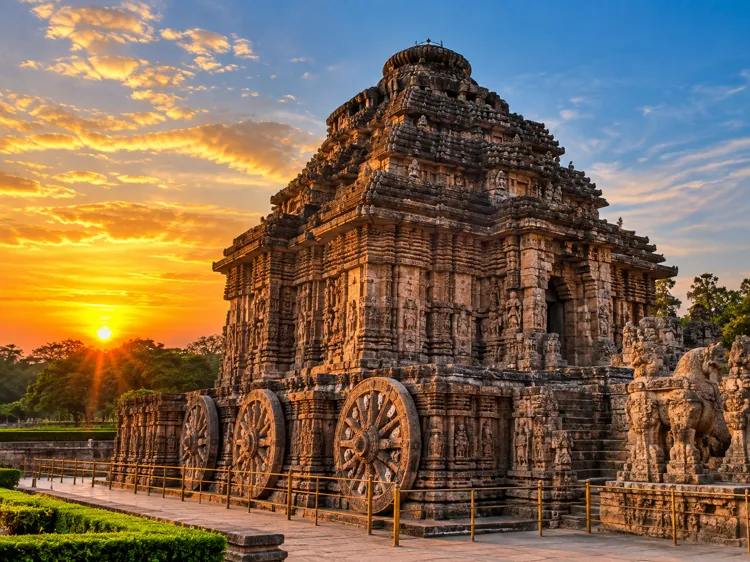
This massive temple, built near the sea, once stood in all its glory in the form of the chariot of the Sun God. Its 24 huge wheels, seven horses, fine stone carvings and construction techniques still attract people even today.
But the most mysterious part of the Konark story is not its beauty. It is the part that remains hidden from our eyes even today.
It is said that at one time, a large part inside the temple was filled with sand and completely closed. More than decades passed — in fact, more than a century has passed since then.
So, what was the reason that this part of Konark had to be closed?
Was it done only to save the temple structure, or was there another story behind it?
This question made me explore the story of the Konark Sun Temple in greater depth.
Let us understand this entire story from the beginning.
🛕 1. The Story of the Konark Sun Temple Begins Not With a King, But With a Son
One part of the Konark story is connected with history, but its roots go back to ancient mythological stories.
According to the legend, Samba, the son of Lord Krishna and Jambavati, was famous for his beauty and attractive personality. But slowly, this same beauty became the reason for his pride.
It is said that he used to make fun of sages and elders.
Sage Narada was not happy with his behaviour. According to the mythological story, he planned to teach Samba a lesson.
After this, an incident happened because of which Samba had to face the curse of Lord Krishna.
Within a short time, his beautiful body became affected by a terrible disease. Painful sores appeared on his body and Samba went through extreme suffering.
When he told his father Krishna about his condition, he was advised to worship the Sun God.
This is where the most emotional chapter of the Konark story begins.
🌅 2. Samba’s 12 Years of Penance and the Blessing of the Sun God
Samba chose Mitra Van, located near the coast of Odisha, as the place for his penance.
It is said that this was the place where the Chandrabhaga River meets the sea.
According to the legend, Samba performed 12 years of hard penance.
Despite the extreme heat, sea winds and difficult conditions, he continued worshipping the Sun God.
Finally, pleased with his penance, the Sun God appeared before him and blessed him with freedom from the disease.
After receiving the blessing of the Sun God, Samba took a bath in the sacred waters of the Chandrabhaga and his body became healthy again.
This experience filled him with deep gratitude.
He decided to build a grand temple dedicated to the Sun God at the same place.
According to the local legend, while bathing, he found a wonderful idol of the Sun God in the flow of the river and installed that idol there.
This is also where the meaning of the name Konark is connected: ‘Kon’ means direction or corner, while ‘Arka’ means Sun.
Therefore, Konark is considered not only an architectural structure, but also a living symbol connected with Samba’s devotion and worship of the Sun God.
🏛️ 3. The Construction of the Konark Sun Temple in History
The mythological story has its own place, but the construction of the massive temple whose remains we see today is connected with the Eastern Ganga Dynasty in history.
This was the same dynasty that is also associated with the construction of the Jagannath Temple in Puri.
According to historians and archaeologists, the present Konark Sun Temple was built during the rule of the powerful Eastern Ganga king Narasimhadeva I.
According to the historical details given, its construction took place approximately between 1238 AD and 1264 AD.
There was not only religious emotion behind this temple. It was also connected with royal power and prestige.
It is said that Queen Mother Kasturi Devi inspired King Narasimhadeva to build such a grand temple in honour of the Sun God that could stand alongside the grandeur of the Jagannath Temple in Puri.
It is said that the king invested resources equal to 12 years of the revenue of his kingdom in this massive project.
This gives us an idea of how large and ambitious the construction of the Konark Temple must have been at that time.
The temple was not only a place of worship, but was also considered a symbol of the political power and achievements of that period.
👷 4. 1,200 Artisans and 12 Years of Hard Work
When King Narasimhadeva I decided to build the temple, the responsibility for this massive project was given to the chief architect of that time, Bishu Maharana.
Under his leadership, around 1,200 skilled artisans were brought from different regions.
Imagine — today we have cranes, modern machines, computer-based designs and advanced construction technology.
But at that time, none of these things existed.
Even then, a massive stone temple was built near the sea.
This is what makes Konark even more special.
It is said that iron plates and clamps were used to join the stones during the construction of the temple. These iron parts were fitted into specially made spaces in the stones, which helped to strengthen the entire structure.
This has been described as similar to a modern interlocking system.
Keeping such a massive structure stable near the sea, surrounded by salty winds and natural movements, must have been a major challenge in itself.
And perhaps this is one of the reasons why the architecture of Konark is still discussed so much even today.
🧲 5. The Biggest Mystery of the Konark Temple: The Floating Idol of the Sun God
Now the story reaches the part where the mystery of Konark becomes even deeper.
According to local legends and the details given, a huge Ashtadhatu idol of the Sun God in the temple’s sanctum was believed to remain suspended in the air without any visible support.
It is described not as a miracle, but as something connected with magnetic power.
According to the story, a huge magnetic stone was placed in the upper part of the temple, which some accounts describe as weighing 52 tonnes.
Heavy iron sheets and clamps were used in other layers of the temple.
The magnetic balance created between all these elements is said to have been the reason why the idol of the Sun God remained suspended in the air.
This is the part where the story of Konark brings together history, local legends and the imagination of ancient engineering.
And connected with this story is the sacrifice of a twelve-year-old boy.
🧒 6. Dharmapada: The 12-Year-Old Boy Who Shocked Everyone
One of the most emotional stories connected with the Konark Sun Temple is the story of Dharmapada.
According to the story, the main construction of the temple was almost complete. But the artisans were not able to successfully place the Kalash on the top of the temple.
The situation became so serious that King Narasimhadeva I warned that if the Kalash was not placed before the next sunrise, the 1,200 artisans would be punished.
Then Bishu Maharana’s 12-year-old son Dharmapada arrived there.
It is said that he understood the structure of the temple and its magnetic system.
At night, he climbed to the huge top of the temple and successfully placed the Kalash.
In the morning, when the first rays of the Sun fell on the top of the temple, everyone present was shocked.
But after this, Dharmapada had another worry.
He was afraid that if the king came to know that a child had completed the work which so many experienced artisans could not do, his father and the other artisans might be punished.
According to the story, to save his father and all the artisans, Dharmapada sacrificed his own life.
He jumped from the top of the temple into the Chandrabhaga River.
Even today, this story remains one of the most touching stories connected with Konark.
🛞 7. Konark’s 24 Wheels: Do They Really Tell the Time?
If you have seen pictures of the Konark Sun Temple, perhaps the first thing that caught your attention was its huge wheels.
The entire temple has been designed in the form of the chariot of the Sun God.
At the base of this chariot, there are 12 pairs, or a total of 24 wheels.
These wheels are considered symbols of the 12 months of the year.
But the most interesting thing about them is their design.
Each wheel has large and small spokes, and it is said that the shadow created between these spokes can be used to estimate the time.
According to the given details, the gap between the large spokes represents around three hours, while the smaller spokes represent smaller periods of time.
So, these are not just decorative wheels.
They show a complete concept of understanding time.
This is why, after seeing the wheels of Konark, even an ordinary traveller stops for a while and tries to understand their design.
And perhaps this is the beauty of Konark: here, art is not only meant to be seen, but also to be understood.
🐎 8. What Do the Seven Horses of the Sun God’s Chariot Represent?
The seven horses placed in front of the chariot of Konark are also very special in their own way.
These seven horses are said to represent the seven days of the week and the seven colours of sunlight.
When you look at the entire chariot together, a wonderful scene appears — as if the chariot of the Sun God is moving forward carrying time and light together.
This is why religious symbols and natural elements appear connected with each other in the architecture of Konark.
The idea behind the temple was not limited only to beauty; symbols related to time, the Sun and nature were also given an important place.
⚔️ 9. How Did the Destruction of the Konark Sun Temple Begin?
Such grandeur did not remain forever.
With time, the temple faced attacks and damage.
In the 16th century, the decline of Konark is connected with the attack of Kala Pahada, the general of Sultan Suleiman Khan Karrani of the Bengal Sultanate.
It is mentioned that around 1568, several major temples of Odisha were targeted.
The Konark Sun Temple is also included among them.
It is said that the temple suffered major damage, although its strong structure made it difficult to completely destroy it.
This is where the end of Konark’s golden period slowly appears to have begun.
🌊 10. Why Was Konark Called the “Black Pagoda”?
Konark was located near the sea. Therefore, its connection was not limited only to religious journeys, but also became connected with sea travel.
According to the given details, during the 16th and 17th centuries, Portuguese sailors and European traders knew it by the name Black Pagoda.
There is also a mysterious story behind this name.
It is said that the effect of the huge magnetic stone present at the top of the temple could be felt as far as the sea.
According to stories connected with the sea diaries and accounts of Portuguese sailors, when their ships passed near Konark, the compass needles on their ships started moving unusually.
Because of this, the ships faced difficulty in finding the correct direction.
Some stories also say that the magnetic effect affected the iron parts of the ships, and some ships met with accidents and sank.
This is why a story developed about fear of Konark among people travelling by sea.
🧲 11. Was the Huge Magnet of the Temple Removed?
Another mysterious part of the Konark story is connected with this magnetic stone.
According to historical claims, Portuguese sailors tried to remove the huge magnet placed at the top of the temple.
It is said that their purpose behind this was to make sea travel safer.
There is a story that after the magnet was removed, it affected the balance of the temple structure.
It is said that the iron lock system holding the stones together was also affected, and the temple slowly started becoming weak.
Although the stories related to these events come somewhere between history and local legends, these are the stories that make Konark one of the most mysterious temples in India.
☀️ 12. Where Did the Main Idol of the Sun God Go?
As the condition of the temple started getting worse, many stories also came up about its main idol.
It is said that the priests tried to remove the main idol of the Sun God from the temple and keep it safe.
According to one story, the idol was kept hidden under the sand for some time.
Later, it is said to have been taken to Puri and installed in the Indra Temple located inside the Jagannath Temple complex.
But even today, one question remains — Is the Sun idol kept in the National Museum in New Delhi actually the original main idol of Konark?
This question is also mentioned among the mysteries connected with Konark.
🌳 13. There Was a Time When Konark Was Lost in the Jungle
Time kept passing.
Worship at the temple decreased, fewer people started visiting, and slowly this massive complex became deserted.
According to the given details, by the end of the 18th century, this area had turned into a dense jungle.
Just imagine — the place where thousands of people once came was now silent among trees and ruins.
Then, at one point, Scottish historian James Fergusson arrived here.
He studied this forgotten temple and, through his drawings, played a role in bringing this lost temple back to the attention of the world.
But after this, another chapter came in the story of Konark that made its mystery even deeper.
🏜️ 14. Why Was the Inside of Konark Filled With Sand?
After remaining in a ruined condition for many years, concerns about the structural condition of the temple increased during the British period.
According to the given details, the then Lieutenant Governor of Bengal arrived at the temple with his team to inspect it.
After seeing the falling stones and weak condition of the temple, he took an important decision.
The four entrances of Jagamohan, meaning the main assembly hall, were closed with stone walls, and an order was given to fill a large part inside it with sand.
The purpose of this was said to be protecting the temple structure from further collapse.
But this is where a question began that has still not ended.
If the purpose was only to save the temple, then why was that part completely closed in this way?
And an even bigger question:
What exactly is hidden under that sand?
Because of these questions, the closed part of Konark is still a subject of curiosity for history, archaeology and ordinary people.
🔬 15. Modern Science Is Now Trying to Understand the Mystery of Konark
Times have changed today.
We have technology that would probably have been difficult to even imagine centuries ago.
Still, opening the closed part of Konark is not an easy task.
The problem is not only about what will be found inside.
The biggest concern is what effect removing the sand will have on the temple structure.
According to the given details, in 2022, the Government of India and the Archaeological Survey of India, or ASI, started working on a plan to remove the sand from this part and open the closed doors.
After this, scientific studies were started to understand the internal structure of the temple.
According to the details given in the context of December 2025, ASI used techniques such as core drilling to understand the strength and condition of the walls.
A detailed structural assessment was also mentioned to have been carried out with IIT Madras.
Recent drilling is said to have indicated that the sand has settled down by around 13.5 metres.
This means that the story of Konark is not over yet.
Many of its chapters are still waiting for scientific investigation.
❤️ 16. What Makes Me Think the Most After Seeing the Konark Sun Temple?
For me, the most special thing about Konark is not its mystery.
What is even more special is that around eight hundred years ago, someone imagined bringing the Sun, time, nature and architecture together in a single structure.
A huge chariot was built.
24 wheels were made in it.
Seven horses were connected to it.
Such fine carvings were made on the stones that even today, they make people stop and look at them carefully.
And behind this entire construction, thousands of people worked hard for many years.
Then time changed.
There were attacks.
The temple became weak.
Worship stopped.
The forests hid it within themselves.
And finally, one part of it was closed under the sand.
But the story of the temple did not end.
Even today, when we look towards Konark, we do not see only a ruin.
We see a question:
How much do we really know about our past?
🌅 17. Konark Sun Temple: An Incomplete Story That Still Calls Us Today
The story of Konark has faith, history, architecture, mystery and many such stories that are still discussed today.
From Samba’s penance to the great construction of King Narasimhadeva I, from the hard work of Bishu Maharana and 1200 craftsmen to the sacrifice story of Dharmapada—every chapter makes this temple even deeper.
Its 24 wheels remind us of time.
Its seven horses point towards the Sun and light.
Its massive structure makes us imagine the ancient construction skills.
And the part closed with sand still puts a question before us, for which we do not yet have a complete answer.
Perhaps in the coming time, modern technology may help us reach those parts of Konark where no one has gone for centuries.
Perhaps a new chapter of history may come out from there.
And perhaps some mysteries will always remain mysteries.
But perhaps this is the greatest beauty of any great historical place.
The Konark Sun Temple does not only ask us to look at our past—it also makes us question our past.
Time weakened its walls, attacks damaged it, forests hid it, and sand covered one part of it.
Still, Konark stands today.
Like a history that has not completely ended.
Like a story whose final chapter is still waiting to be written.
📺 References
Video: Mystery of Konark Sun Temple | The Real History
Website: Wikipedia
Website: culture.gov.in