


Mahabalipuram Tamil Nadu: Complete Guide to History, Temples & Places to Visit
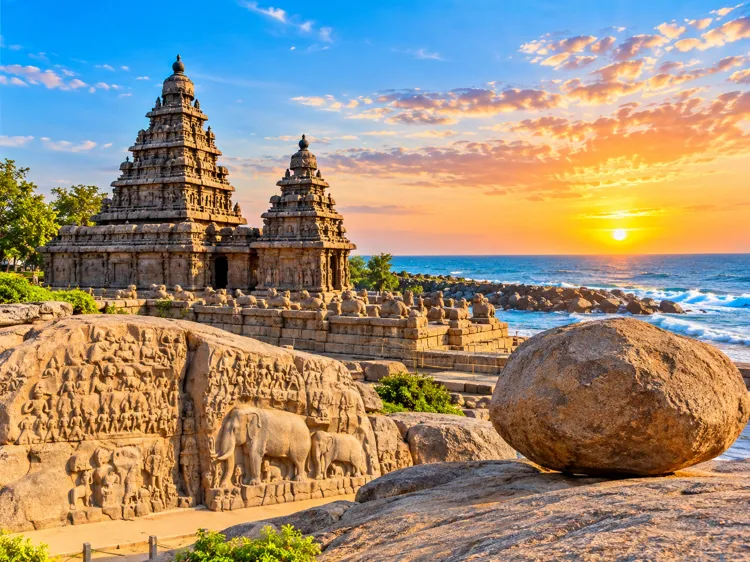
🏛️ Mahabalipuram Tamil Nadu: An Amazing World of Ancient Stone Art Built by the Sea
Mahabalipuram Tamil Nadu is not just the name of a tourist destination, but it is a place that holds India’s ancient stone art, temple architecture, and the amazing artistic tradition of the Pallava period. Here, history and the sea can be seen very close to each other. Ancient temples standing near the waves of the sea, figures carved on huge stones, cave architecture, and centuries-old constructions give this place a different and emotional experience.
When a traveller moves towards Mahabalipuram, they do not see only monuments made of stones. Every artwork here seems to hide a story, a belief, and a glimpse of ancient life within itself. This is why, whenever the name Mahabalipuram comes up, the amazing tradition of ancient Indian architecture and stone art comes to mind.
The relationship between the sea and monuments in Mahabalipuram is one of the most special experiences of this place. The Shore Temple, located near the sea, is one of the most impressive examples of this. The sound of the waves and the peaceful atmosphere of the ancient temple together create a scene that can remain in the memory of anyone who sees it for a long time.
If you want to understand India’s historical and cultural tourist destinations closely, you can also explore travel-related content on Duniya Ghumo 360.
🌊 1. The Unique Relationship Between Mahabalipuram and the Sea
The sea has a special place in the identity of Mahabalipuram. The given details repeatedly mention the sea, the seashore, sea routes, and the Shore Temple. This sea environment gives the ancient monuments of Mahabalipuram a different appearance.
Imagine huge waves of the sea on one side and centuries-old stone temples on the other side. When ancient sculptures are seen along with the sound of the waves, it feels as if the present time has gone back for a while.
The experience of Mahabalipuram does not remain limited to just seeing the place. The ancient constructions here also create many questions in the mind. How would such detailed artwork have been created on such huge stones? How deep would the imagination of the artists of that time have been? How were stone shapes created and figures that looked alive carved into them?
These questions make the journey to this place even more emotional.
🛕 2. Shore Temple: An Ancient Symbol Standing by the Sea
Among the most famous monuments of Mahabalipuram, the Shore Temple is mentioned prominently. This ancient temple located near the sea is an important part of the identity of Mahabalipuram.
In the source material, the Shore Temple is described as an ancient construction and temple. The period of Pallava King Narasimhavarman is also mentioned. The combination of the sea and ancient architecture around the temple gives it a special view.
Standing near the Shore Temple and looking towards the sea can itself be an experience. In front, the sea waves continue to move, while behind them stands a centuries-old stone construction. This scene brings two different forms of time together.
On one side, nature keeps changing continuously, while on the other side, ancient stone art preserved in stone still exists today. This contrast makes the beauty of Mahabalipuram even deeper.
The source also mentions European sailors and sea routes. This indicates that the identity and connection of this place through sea routes have also been discussed in older references.
🗿 3. Pallava Empire and the Stone Art Tradition of Mahabalipuram
It is difficult to understand the story of Mahabalipuram without the context of the Pallava Empire. The given text mentions the Pallava Empire, Pallava King Narasimhavarman, and the amazing stone art created during the Pallava period at several places.
Instead of seeing stone only as a construction material, using it as a medium of artistic expression appears to be a special feature of this tradition. The figures carved on huge rocks and the cave temples in Mahabalipuram show a glimpse of this stone art tradition.
When a traveller visiting this place sees a figure carved on a stone wall, it does not remain just a figure in front of them. It makes them think about the imagination, art, and religious feelings of that time.
The stone art of Mahabalipuram also feels emotional because there is an attempt to show life through a hard medium like stone. Figures of elephants, animals, deities, meditation, and religious scenes expand this ancient artistic world.
🧘 4. Arjuna’s Penance and the Story of the Ganga
Among the most amazing sculptures of Mahabalipuram, Arjuna’s Penance is mentioned. The source describes the story related to Arjuna, ascetics, Bhagiratha, and the Ganga River.
This huge sculpture presents an imagination connected with penance and the story of the Ganga coming down to the earth. The source also gives the episode of Bhagiratha’s deep penance and the Ganga River coming from heaven towards the earth.
When a person stands in front of this sculpture, they do not see only the surface of the stone. They can feel an entire story taking shape in stone.
The episode of Arjuna’s Penance presents a beautiful connection between the Indian storytelling tradition and ancient stone art. The combination of many figures on the huge stone surface gives the feeling that the artist was not creating only one figure, but was trying to bring an entire scene to life.
This is why this stone art of Mahabalipuram is not only something to see, but also an experience to understand and feel.
🐄 5. Krishna Mandapam: Rural Life Seen in Stone
Krishna Mandapam is also mentioned among the important stone art sites of Mahabalipuram. The source mentions that the sculptures connected with this place show scenes related to rural life, animals, Gopis, and Krishna.
The speciality of Krishna Mandapam gives the feeling that ancient stone art was not limited only to gods and goddesses. It could also show glimpses of the life and society of that time.
The depiction of rural life, animals, and human figures makes the stone surface look alive. When we look at these sculptures, it feels as if the life of an old time has stopped in front of us for a few moments.
Krishna Mandapam can also become an important experience during a visit to Mahabalipuram because here, along with religious feelings, the normal activities of life can also be seen in an artistic form.
🗿 6. Mahishasuramardini Cave: A Combination of Power and Stone Art
Mahishasuramardini Cave Temple is also mentioned among the places in Mahabalipuram. This place looks special because of the sculptures related to Goddess Durga and Mahishasuramardini.
In the source, Mahishasuramardini is described as a form of power fighting against evil forces. The sculpture also gives a feeling of drama and power.
For ancient artists, presenting a story in stone was not only about making figures. They tried to create emotions through facial expressions, body movements, and the surrounding structure.
The mention of Mahishasuramardini Cave brings forward the artistic tradition of Mahabalipuram, where an attempt was made to present religious stories visually in stone.
🐗 7. Varaha Cave and the Avatar of Vishnu
Varaha Cave also appears to have an important place in the stone art tradition of Mahabalipuram. The source mentions sculptures related to the Varaha avatar and Vishnu.
Carving the idea of the Varaha avatar on stone brings forward both the religious and artistic features of ancient stone art. Here, a scene related to the Varaha form of Vishnu is presented through sculpture.
When a story is told through stone instead of words, the experience of understanding that story becomes different. This is the beauty of the sculptures of Mahabalipuram.
The mention of Varaha Cave also shows that different religious stories in Mahabalipuram were presented through different architectural forms and stone art mediums.
⚫ 8. Krishna’s Butter Ball: An Amazing View of Nature and Mystery
Among the most interesting monuments of Mahabalipuram, Krishna’s Butter Ball is also prominently mentioned in the source.
This huge stone creates a different attraction because of its shape. When a large stone is seen standing in such a position that it appears stable in its place, it naturally raises a question in the mind about how it is standing there.
This mystery gives Krishna’s Butter Ball a different experience from the other monuments of Mahabalipuram.
During a visit to Mahabalipuram, while the temples and caves tell the story of ancient religious and stone art traditions, Krishna’s Butter Ball creates curiosity about nature, stone, and balance.
Standing here, a person looks at the huge stone and, for some time, moves beyond their normal way of thinking. Perhaps this is the beauty of travel—it does not only show us a place, but also makes us think.
🏛️ 9. Monolithic Constructions of Mahabalipuram
The source mentions the monolithic constructions and amazing stone art of Mahabalipuram. The idea of monolithic construction itself shows the depth of the stone art tradition of this place.
Cutting and shaping a huge stone structure into an architectural form appears to be a challenging artistic effort in itself. Examples of this type of stone art tradition are mentioned among the different monuments of Mahabalipuram.
When a person visits this place and looks at the different monuments, they get an opportunity to understand how ancient artists may have tried to shape stone according to their artistic imagination.
This is why Mahabalipuram does not feel like only a group of temples, but gives the experience of a huge open stone art workshop.
🌅 10. The Sea, Sunrise and Emotional Experience of Mahabalipuram
The sea appears again and again in the identity of Mahabalipuram. The monuments located near the sea give this place a special visual atmosphere.
The peaceful morning atmosphere, the waves of the sea, and the ancient architecture visible in the distance—all these together can become a memorable experience for any traveller.
The source contains references to sunrise, the seashore, and views of the temples. These references help us imagine the atmosphere of Mahabalipuram, where natural beauty and historical monuments can be seen together.
Many times, the most beautiful part of a journey is not seeing a particular monument. It is the moment when we stand quietly for some time and feel the place.
The ancient monuments standing among the waves of the sea in Mahabalipuram seem to offer exactly this kind of experience.
🏺 11. The Caves of Mahabalipuram and Stories in Stone
Special mention is also found about the cave temples and sculptures in Mahabalipuram. Mahishasuramardini Cave and Varaha Cave appear as the main examples in the source.
The speciality of these caves is that here, stone is not only a wall or ceiling. The same stone becomes a medium for telling stories.
Figures related to Goddess, Vishnu, Varaha, Mahishasuramardini, and other religious stories make this stone art tradition richer.
When entering the caves, a different kind of feeling can arise in the mind of a traveller. Outside, there is the sea and an open environment, while inside, ancient sculptures and stories can be seen among the stones.
This change makes the journey to Mahabalipuram even deeper.
🌏 12. UNESCO and the Heritage of Mahabalipuram
The source material mentions the monuments of Mahabalipuram and the UNESCO World Heritage several times. This gives an indication of the importance of the historical and cultural heritage of Mahabalipuram.
While looking at these monuments, it does not seem enough to focus only on their beauty. The ancient stone art tradition, architecture, and cultural memory connected with them are also important.
The figures carved on stone continue to attract people even after a very long period of time. This is the power of heritage—it continues to connect future generations with itself, far beyond the time in which it was created.
In this sense, Mahabalipuram presents a living historical experience.
❤️ 13. Why Does Mahabalipuram Touch the Heart?
Perhaps the complete experience of Mahabalipuram cannot be understood by seeing it only as a tourist destination. This place becomes emotional because nature, history, religion, and stone art can all be seen together here.
The waves of the sea keep changing continuously, but the stone monuments standing in front of them tell a different story of time.
On one side is the present, and on the other side is the past.
On one side is the natural power of the sea, and on the other side is stone artwork created by human hands.
On one side are the waves that keep moving forward every moment, and on the other side are the sculptures that have been standing there for centuries and preserving history.
This contrast makes Mahabalipuram emotional.
📸 14. What Should You Feel in Mahabalipuram?
A visit to Mahabalipuram should not be limited only to taking photographs. Spending some time looking at each monument here can make the experience of this place deeper.
Near the Shore Temple, one can feel the relationship between the sea and the temple.
Standing in front of the sculptures of Arjuna’s Penance, one can try to understand the story and figures shown in it.
At Krishna Mandapam, the sculptures related to rural life and animals can be seen.
At Mahishasuramardini Cave, the sculptures related to power and struggle can be felt.
At Varaha Cave, the sculptures related to the Varaha form of Vishnu can be seen.
And standing in front of Krishna’s Butter Ball, its huge form and mysterious balance can be observed.
In this way, the journey to Mahabalipuram goes beyond one monument and becomes a complete cultural journey.
🧭 15. Mahabalipuram: A Place to Feel History, Not Just See It
There are many historical places in India, but Mahabalipuram has its own unique identity. Here, ancient monuments standing near the sea, stories carved on stone, and the stone art tradition of the Pallava period can all be seen together.
The importance of Mahabalipuram is also that history does not appear to be kept safe inside a closed room here. It can be seen in the open environment, on huge stones, and near the sea.
When the sea breeze touches the face and centuries-old stone art can be seen in front, the travel experience does not remain limited to information. It becomes a feeling.
This is the feeling that makes a historical journey memorable.
🌴 16. The Biggest Beauty of a Visit to Mahabalipuram
Perhaps the biggest beauty of Mahabalipuram is its diversity.
There is the sea here.
There are temples here.
There are caves here.
There are huge sculptures here.
There is a story like Arjuna’s Penance here.
There is the imagination of the Ganga coming down to the earth here.
There is a glimpse of rural life in Krishna Mandapam here.
There is a feeling of power in Mahishasuramardini here.
There is the form of Vishnu in Varaha Cave here.
And there is also a mystery like Krishna’s Butter Ball here.
When all these are seen together, Mahabalipuram does not remain just a place. It gives the experience of a long story of Indian stone art and cultural memory.
✨ Final Words: The Memory of Mahabalipuram Like the Waves of the Sea
Some journeys remain in photographs, and some journeys remain in the heart.
Mahabalipuram Tamil Nadu gives the experience of such a journey, where along with the waves of the sea, the voice of history can also be felt.
The ancient beauty of the Shore Temple, the stone art of the Pallava period, Arjuna’s Penance, the story related to the Ganga, the rural scenes of Krishna Mandapam, the power of Mahishasuramardini Cave, the religious stone art tradition of Varaha Cave, and the mystery of Krishna’s Butter Ball—all these together create such a picture of Mahabalipuram that is not easy to completely describe in words.
Here, the stones feel as if they are speaking.
The sea seems to be telling a story.
And history appears to be standing in front of us.
Perhaps this is why the memory of Mahabalipuram remains in the mind even after the journey is over. The waves of the sea return again and again, but every time they seem to bring with them a new feeling of that ancient heritage.
If you want to read more information related to India’s historical heritage, ancient temples, and beautiful tourist destinations, you can also visit Duniya Ghumo 360 .
Mahabalipuram Tamil Nadu – Where history still appears alive in the stones beside the sea.
📺 References
Video: Mahabalipuram Secrets | The Lost City of Stone | UNESCO Heritage Wonders
Website: wikipedia
Website: culture.gov.in