


Bhopal to Sanchi and Udayagiri Journey: History, Stupas & Ancient Caves
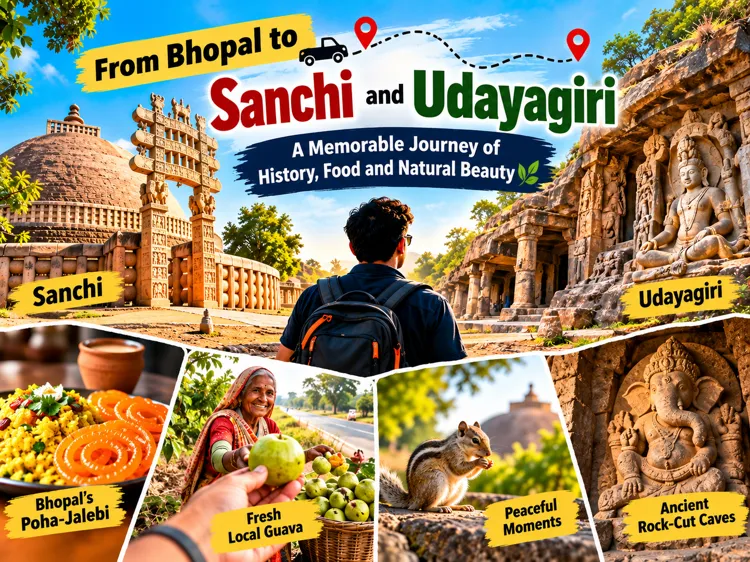
🧭 Bhopal to Sanchi and Udayagiri: A Memorable Journey Full of History, Flavours and Peace
Some journeys are not only about covering a distance. Some journeys connect us with the people we meet on the way, local flavours, ancient history, peaceful surroundings, and small unexpected moments.
This journey from Bhopal to Sanchi and Udayagiri was also something like that.
In the morning, I was in Bhopal. I had the whole day ahead of me, and the plan was to first visit Sanchi and see the famous stupas, then explore the ancient caves of Udayagiri, and if there was enough time, also reach Raisen Fort.
But like any real journey, this trip also did not go completely according to the plan.
At some places, hot poha-jalebi made me stop, at some places fresh guavas on the roadside caught my attention, at some places the artworks carved on centuries-old stones made me stop and think, and somewhere I spent almost one full hour searching for dal bafle.
In the end, Raisen Fort was left for this journey, but I got the opportunity to explore Sanchi and Udayagiri with comparatively less crowd.
And perhaps, this was the most beautiful part of this journey.
🍯 1. Bhopal Morning with Poha-Jalebi
At around nine in the morning, I was in Bhopal.
Before leaving towards Sanchi, I decided that it would not be right to start the journey without having Bhopal’s famous breakfast.
I reached Anand Sweet, located in the MP Nagar area. The driver had told me that the poha here is quite famous.
Hot poha and jalebi came in front of me.
The poha was very hot and soft. The jalebi was also hot, and this combination felt perfect for starting the morning.
The last time I explored Bhopal, I missed having poha-jalebi because I had reached a little late. So this time, one of the reasons for leaving early in the morning was also to definitely taste this famous breakfast of Bhopal.
From the local conversation, I came to know that in Bhopal, poha, jalebi and samosa are not just food items, but a part of the everyday food tradition.
When a journey starts with local flavours, the trip gets a different feeling of connection.
☕ 2. Strong Tea in Bhopal and a Small Meeting on the Way
After poha-jalebi, I felt like having tea.
Some people sitting there saw me shooting and started a conversation. They asked which channel it was and what I was doing.
Such a sudden conversation makes any journey a little more memorable.
After that, I had a strong cup of tea and then prepared to move ahead.
On the way, I also met a baba. He asked for food. Instead of giving him money, I asked him to have food, but he refused.
The meeting was small, but sometimes the unknown people we meet during a journey become a part of our memories.
Now the journey towards Sanchi had started.
🛣️ 3. A Beautiful Journey from Bhopal Towards Sanchi
While moving ahead from Bhopal, I saw a special place on the way.
There was a board on the main road, and a mark was also made on the road—Tropic of Cancer.
When you find such unexpected things during a journey, the road becomes even more interesting.
Sanchi was around 19 kilometres from here.
But the next small stop on this journey was not Sanchi, but the fresh guavas being sold on the roadside.
🍈 4. Fresh Guavas from Amma Ji on the Roadside
An Amma Ji was selling guavas on the roadside.
I asked the price of the guavas. I was alone, so I did not feel it was right to buy many. I asked her to cut one guava for me.
During the conversation, I asked whether the guavas were from her farm or whether she had bought them. She told me that there were farms around the area.
I told her to give me whichever one she liked.
She gave me a guava with love.
The guava turned out to be very fresh and sweet.
I wanted to pay her, but there was a different kind of warmth in her behaviour.
At that moment, I felt that the best memories of a journey are not always made at big tourist places.
Sometimes, even a few minutes of meeting an unknown person on the roadside stays in our heart for a long time.
🏛️ 5. Reaching Sanchi and Facing History
Finally, I reached Sanchi.
I took the ticket from the ticket window and moved ahead.
There was around one kilometre of climbing to reach the top.
After reaching the top, I saw the parking area and the entrance gate in front.
There were not many tourists that day. For me, this was a good thing because seeing a historical place with less crowd gives a different kind of experience.
In front of me was the famous Sanchi Stupa.
Standing in front of a place that I had read about in history books was a completely different experience.
There was a lot of detailed information given there. It would take quite a lot of time to read and understand everything properly, so I took a guide.
And from here, my journey of understanding the history of Sanchi began.
🪷 6. History of Sanchi Stupa and Ancient Heritage
Guide Santosh Yadav started giving information about the Sanchi Stupa and its history.
According to him, the history of this place goes back from the 3rd century BCE to the later centuries.
The construction of the early stupa is associated with Emperor Ashoka, and later, expansion and construction continued at different times.
One of the most attractive features of Sanchi is its four Torana gateways:
- North Gate
- South Gate
- East Gate
- West Gate
The artworks and stories carved on these Toranas are the identity of Sanchi.
Many scenes related to the Jataka stories of Buddha can be seen here.
At some places, Buddha’s footprints can be seen, while at other places, his presence has been shown through symbols.
The guide also told us that Buddha himself did not come to Sanchi.
Even then, the artistic expression of Buddhist traditions and stories related to Buddha’s life can be seen very deeply at Sanchi.
🗿 7. Amazing Carvings on the Torana Gateways of Sanchi
When we look carefully at the Torana gateways of Sanchi, we understand how carefully ancient artists must have worked on the stones.
Figures of elephants, horses, humans, gatekeepers and different religious scenes have been carved on these stones.
At many places, scenes related to Buddha have been presented through symbols instead of showing them directly.
Buddha’s footprints are one example of this.
After seeing these artworks, it feels as if the stones themselves are telling stories.
Today, we can read or watch a story on a mobile phone within a few seconds, but at that time, artists preserved these stories in stones through their art.
This is one of the greatest beauties of Sanchi.
🏺 8. Ancient Sculptures, Temples and Stone Art
In the Sanchi complex, many remains related to different periods can be seen.
At some places, there are ancient stones, at some places, remains of temples, at some places, sculptures, and at some places, parts of pillars.
Some sculptures have been damaged with time, but even their remaining parts tell the story of history.
At many places, the names of donors can also be seen in the Pali language.
There is also a mention of a Buddha statue in a small temple here.
While seeing Sanchi, one feels that it is not just a stupa, but a complete historical complex that contains layers of many different periods within it.
🪨 9. Ashoka Pillar and Amazing Polish of the Stone
The remains of the Ashoka Pillar can also be seen at Sanchi.
Some broken parts of it are present there, and its upper part was said to be kept in the Sanchi Museum.
The surface of the stone of the pillar looks very smooth.
From a distance, the stone may look ordinary, but after going close, its polish and smoothness can be clearly seen.
It was said to have been made from stone from Chunar Garh, Uttar Pradesh.
Sometimes, to understand history, it is enough to carefully look at just one stone instead of a large monument.
The hard work visible on that stone gives a feeling of the art and technology of its time.
🌳 10. Emperor Ashoka and the Buddhist Tradition of Sanchi
Emperor Ashoka is said to have an important place in the story of Sanchi.
The guide also told us about Emperor Ashoka’s wife Vidushi Devi and her connection with Buddhism.
The Viharas and other structures present at Sanchi give a glimpse of life during that time.
It was told about one Vihara that Emperor Ashoka’s children Mahendra and Sanghamitra studied here and later went to Sri Lanka carrying a Peepal tree, where they became associated with the spread of Buddhism.
While listening to these stories, Sanchi does not feel like just a tourist place.
It becomes a long story of history, education, religion and lifestyle.
🧘 11. Lessons of Simplicity and Peace from Sanchi
While exploring Sanchi, the most noticeable thing was the peaceful atmosphere there.
There were small rooms in the Viharas.
Separate places for Buddhist monks and teachers to stay are mentioned.
There was also a donation bowl, where people used to give alms.
Life at that time must have been quite simple compared to today.
Meditation, gaining knowledge and being satisfied with whatever was available—this thought makes the experience of Sanchi not only historical, but also emotional.
Today, our needs have increased.
We have more facilities, but peace of mind does not always come with facilities.
Sitting on the peaceful hill of Sanchi, this can be felt even more.
🐿️ 12. A Small Meeting with a Squirrel in Sanchi
After seeing the history, I sat down for some time.
Then a squirrel started coming very close to me.
I did not have anything to eat that I could give it.
In the middle of such a large historical complex, this small incident felt very sweet.
Perhaps this is the beauty of travelling.
You go to see a great monument, but sometimes your most memorable picture or memory becomes connected with a small incident.
🏺 13. Archaeological Museum of Sanchi
There was also a museum near the Sanchi complex.
I took a ticket for five rupees and went to see the Archaeological Museum Sanchi.
After seeing the ancient structures and sculptures in the open Sanchi complex, the experience of the museum makes this journey even richer.
Seeing the remains of history in a different environment makes the experience of understanding the whole complex even deeper.
🍛 14. Sanchi to Udayagiri: In Search of Dal Bafle
After exploring Sanchi, it was afternoon.
Now the next stop was Udayagiri.
But before going ahead, it was necessary to have lunch.
I especially wanted to eat Dal Bafle.
I left Sanchi at around quarter to two and decided to go through Vidisha.
Compared to the direct route, this route was a few kilometres longer.
But the problem was that Dal Bafle was not available anywhere.
Almost one hour passed while searching for food from one place to another.
Many places were closed, at some places food was not available, and at some places I did not find the kind of food I wanted to eat.
Finally, I found Raj Darbar Restaurant.
I asked there about Dal Bafle.
Dal was available, but Dal Bafle was not available.
Then I decided to eat whatever was available.
🍽️ 15. Raj Darbar Restaurant: The Food Was Better Than Expected
In the beginning, I felt a little doubtful after seeing the restaurant.
I had been searching for food for quite some time, and the place was also not very crowded.
The question in my mind was how the food would be.
But when the food came in front of me, the experience was completely different from what I expected.
The food was very good.
After travelling for so long, getting hot food in front of me was itself a relief.
And the taste was also better than expected.
One hour was definitely spent in searching, but finally getting good food reduced the trouble of that time a little.
Sometimes, while travelling, the best thing is found at the place from where you expect the least.
🐆 16. Leopard Warning as Soon as I Reached Udayagiri
After eating, I reached the Udayagiri Caves.
There was a parking area and ticket window in front.
After taking the ticket, I went inside.
Near the entrance, there was an important warning that a leopard was moving around in the upper area of the hill.
Therefore, going to the upper area was prohibited.
So, instead of going up, I decided to see the main caves located below.
At that time, there were not many tourists there.
On one side, this made the place feel quite peaceful, but because I was alone, it was also necessary to be a little careful.
Along with the excitement of seeing history, it was also important to pay attention to the surroundings.
🕉️ 17. Ancient Caves of Udayagiri and Sculptures of Gods and Goddesses
Udayagiri was said to have a series of 20 caves in total.
Among these, caves number one and twenty were said to be connected with the Jain tradition, while the remaining caves have sculptures and temples related to the Hindu tradition.
In the caves, figures of Lord Shiva, Lord Vishnu, Lord Ganesha, Mahishasura Mardini and other figures can be seen.
Every cave seems to contain a different story within itself.
Looking at these structures carved inside the hill, it is also difficult to imagine how the artists must have worked at that time.
🐘 18. Ancient Ganesha Statue and Mahishasura Mardini
In one cave, a statue of Lord Ganesha can be seen.
It was described as one of the world’s oldest seated statues of Ganesha.
Nearby, there is a statue of Lord Vishnu and figures of the gatekeepers.
In the statue of Mahishasura Mardini, a scene can be seen where the Goddess is pressing Mahishasura under her feet.
After seeing the fine details of the sculptures, the same thought comes again and again—how could such a high level of art have been created on stone in such ancient times?
🎶 19. Veena Cave and the Ancient Shivling
Cave number four of Udayagiri is called the Veena Cave.
A figure playing the Veena can be seen in the carving above it, and therefore it is called the Veena Cave.
Inside the cave, there is a one-faced Shivling of Lord Shiva.
The face of Lord Shiva can be seen on the Shivling.
This statue feels like a beautiful example of the fine details of ancient stone art.
🌊 20. Amazing Statue of Lord Vishnu in Cave Number 13
Cave number 13 is one of the important caves of Udayagiri.
Here, a special statue of Lord Vishnu can be seen, in which he is shown lying on Sheshnag.
A figure of Garuda was also said to be present nearby.
The fine carving on the crown of Lord Vishnu especially attracts attention.
Figures of gods and goddesses have also been carved above and around the statue.
The most special thing is that the entire statue was said to have been made from a single stone.
The stone has been worked on with such fine details that by seeing it, one can understand the level of craftsmanship of the ancient artists.
🌊 21. Amrit Cave and Samudra Manthan
Cave number 19 is known as the Amrit Cave.
The scene of Samudra Manthan can be seen here.
Vasuki Nag is shown as a rope. On one side, the gods are shown pulling it, and on the other side, another force is shown pulling it, while Mount Sumeru can be seen in the middle.
With time, many sculptures have become damaged and broken.
Therefore, one has to look carefully to see these scenes.
Even then, whatever remains is enough to make us feel the depth of the artistic imagination and craftsmanship of that time.
🌿 22. Less Crowd and More Peace in Udayagiri
Perhaps the best experience of the Udayagiri journey was its peaceful environment.
There were not many tourists there.
Only two or four tourists could be seen.
Because of this, there was an opportunity to see the ancient caves without much noise and crowd.
A pond could be seen in front.
There were old caves all around and figures carved on the stones.
In such an environment, standing quietly for some time also becomes a part of the journey.
If there had been too much crowd, perhaps this experience would not have been possible.
🌅 23. Why Was Raisen Fort Left Out?
By the time I reached the parking area back from Udayagiri, it was around five in the evening.
Now the next target was Raisen Fort.
But it would take around one hour to reach there.
In winter, evening comes early, and entry was not possible after it became dark.
Therefore, Raisen Fort had to be left out of this journey.
If the extra time spent searching for Dal Bafle in the afternoon had been saved, perhaps Raisen Fort could also have been seen.
But it is not necessary to see every place in a single day during a journey.
Some places become memories of the first journey, while some become a reason for the next journey.
Raisen Fort has also now been saved for the next journey.
❤️ 24. Memories from the Bhopal to Sanchi and Udayagiri Journey
When I left Bhopal in the morning, I had a simple travel plan in front of me.
Bhopal to Sanchi.
Sanchi to Udayagiri.
And if there was enough time, Raisen Fort.
But by the end of the day, this was no longer just a journey to three tourist places.
It had hot jalebi from Bhopal.
Hot poha.
Strong tea.
Conversations with local people.
Fresh guava received from Amma Ji on the roadside.
The Tropic of Cancer marker.
Centuries-old stupas of Sanchi.
Stories related to Buddha.
Carvings on the Torana gateways.
The Ashoka Pillar.
Old Viharas.
A small squirrel.
The search for Dal Bafle.
Food at Raj Darbar that was better than expected.
The peaceful caves of Udayagiri.
An ancient Ganesha statue.
The Veena Cave.
The ancient Shivling.
The statue of Lord Vishnu lying on Sheshnag.
The story of Samudra Manthan.
And finally, because of the lack of time, Raisen Fort being saved for the next journey.
This is the real journey.
We think that we are going to see a particular place.
But in reality, the road gives us many such experiences that we had not even planned.
🌿 25. Sanchi and Udayagiri: A Peaceful Experience Along with History
The thing that stayed in my mind the most during this journey was simplicity and peace.
While listening about the old Viharas of Sanchi and the life of the monks, thoughts of meditation and knowledge come to mind.
Today, we have many facilities.
Our needs have also increased.
But even then, many times, peace of mind comes from a peaceful hill, an old cave or a small natural incident.
A guava received from an unknown Amma on the roadside can also be remembered more than an expensive meal.
And the restaurant from which we do not expect much can give the best food experience of the journey.
This is the beauty of travelling.
🏞️ 26. Do Not Just See Sanchi and Udayagiri, Feel Them
Considering historical places like Sanchi and Udayagiri only as tourist destinations would make their experience smaller.
Every stone present here seems to be connected with some story.
Every statue shows the art of its time.
Every cave gives a different glimpse of ancient life and religious traditions.
The stupas and Toranas of Sanchi bring forward stories related to Buddha.
The caves of Udayagiri show ancient craftsmanship related to Shiva, Vishnu, Ganesha and other gods and goddesses.
When we look carefully at these sculptures, we do not see only stones.
We can see the hard work of the artist behind them.
We can see his imagination.
We can see his time.
And perhaps this is the greatest experience of a historical journey.
✨ 27. Final Words: Some Journeys Never Really End
By evening, it was time to return to Bhopal.
Raisen Fort was left out of this journey.
But perhaps incomplete journeys are also necessary.
Because the place that is left out becomes the reason for the next journey.
Sanchi connected me with history.
Udayagiri gave me peace.
Bhopal gave me flavours.
The people on the way gave me a feeling of belonging.
And a one-day journey gave me many such memories that will stay with me for a long time.
This journey from the hot poha and jalebi of Bhopal to the peaceful ancient caves of Udayagiri was not just a journey of kilometres.
It was a journey from flavours to history, from people to stones and from crowds to peace.
Perhaps this is the most beautiful thing about travelling.
We start on the road thinking about what we want to see.
But the road gives us much more than that.
And sometimes, a hot poha, a sweet jalebi, a fresh guava from a farm, a centuries-old stupa, a statue of Lord Vishnu carved in stone, a peaceful cave and a small squirrel become the most beautiful memories of a journey.
Raisen Fort was left for this time… perhaps the next journey will be to complete that unfinished story.
📌 28. Main Attractions of This Journey
- 🥣 Hot Poha-Jalebi of Bhopal
- ☕ Strong Tea and Local Meetings
- 🍈 Fresh Guavas on the Roadside
- 🏛️ Famous Stupa of Sanchi
- 🪷 Ancient Torana Gateways of Sanchi
- 🗿 Ancient Sculptures and Stone Art
- 🪨 Ashoka Pillar
- 🏺 Archaeological Museum Sanchi
- 🕉️ Ancient Caves of Udayagiri
- 🐘 Ancient Ganesha Statue
- 🎶 Veena Cave
- 🌊 Sculptures of Samudra Manthan
- 🐍 Statue of Lord Vishnu on Sheshnag
- 🌿 Peaceful and Less Crowded Environment
- 🏰 Raisen Fort — Left for the Next Journey
📺 References
Video: Sanchi Stupa & Udaygiri Rock Cut Caves
Website: GetYourGuide
Website: Incredibleindia.gov.in