


Chittorgarh Fort History: Valor, Jauhar & Meera Bai Temple
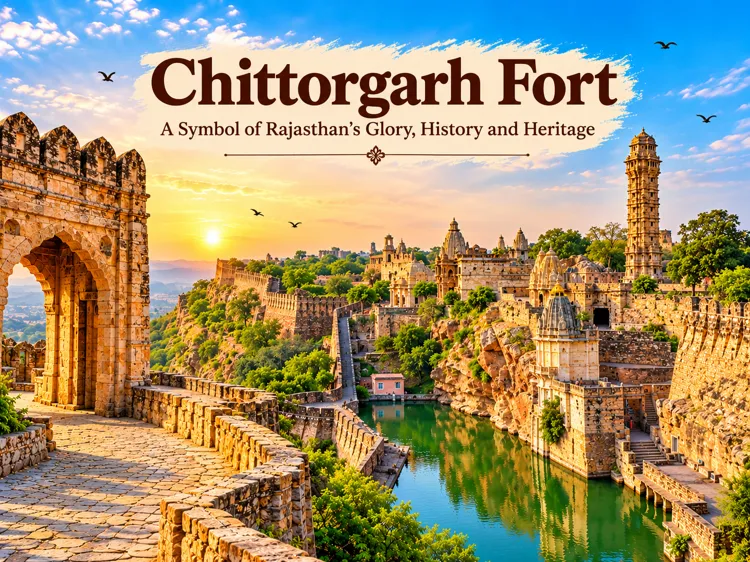
🏰 Chittorgarh Fort Rajasthan: History, Valor, Jauhar, Meera Bai Temple and a Complete Travel Experience
There are some places in Rajasthan where, when you arrive, you do not just see history with your eyes, but also feel it with your heart. Chittorgarh Fort is one of those historical places. Its huge walls, tall entrance gates, ancient temples, water structures, and buildings that have turned into ruins remind us of a time when protecting the motherland, honour, sacrifice, and self-respect were considered the greatest values of life.
Chittorgarh Fort is not just a historical fort made of stones. It is a story of Mewar’s glory, the courage of brave warriors, Rajput traditions, spiritual faith, and standing up for one’s honour even in difficult situations.
Imagine that you are standing in front of the first entrance gate of the fort. In front of you are centuries-old defensive walls. The road slowly takes you towards the higher part of the hill. As you move ahead, you see memorials of brave warriors at some places, beautiful pillars of old temples at others, and stepwells whose design reminds us of the water management system of those times.
After walking some distance, you enter the world of Meera Bai’s devotion to Lord Krishna. On the other side, religious places like Kumbha Shyam Temple and Kalika Mata Temple show the spiritual heritage of this fort.
This is what makes Chittorgarh special, history, faith, architecture, and emotions can all be experienced together here.
If you want to understand Rajasthan’s historical heritage closely, a visit to Chittorgarh Fort can become a memorable experience for you.
🏰 1. Where Is Chittorgarh Fort Located and What Are Its Main Features?
Chittorgarh Fort is a huge historical fort located in Chittorgarh, Rajasthan. According to the provided material, it covers around 700 acres on the plateau of Chitrakoot Hill and is situated on a hill approximately 180 metres high.
The size of the fort can be understood from the fact that it contains a vast collection of entrance gates, defensive walls, temples, palaces, water reservoirs, and old residential areas.
Another special feature of this fort is that it is not just a monument from the past, but also a living historical complex. The provided material mentions that more than 5,000 people still live inside the fort.
Because of this, you can experience a unique combination of history and present-day life here.
The main features of the fort include:
- A historical fort spread across a large hill.
- Seven entrance gates built for security.
- Memorials built in memory of brave warriors.
- Ancient temples and religious places.
- Stepwells and structures used for storing water.
- Old palaces, ruins, and historical buildings.
- Stories of bravery and sacrifice connected with the history of Mewar.
Simply visiting the famous places is not enough to understand Chittorgarh. Its real beauty is also hidden in the roads, walls, and structures that show how arrangements were made to protect such a huge fort.
📜 2. History of Chittorgarh Fort: From Chitrakoot Hill to the Glory of Mewar
The history of Chittorgarh Fort goes back many centuries. According to the provided text, the beginning of its construction is associated with Chitrangad Maurya. The material mentions both the fifth and seventh centuries in connection with its early construction. Therefore, instead of treating these dates as one confirmed date, it is appropriate to understand them as part of the historical tradition described in the source.
According to the same material, Bappa Rawal later took control of this fort and laid the foundation of the Guhil dynasty. Over time, later rulers expanded the fort. Gradually, it became the capital of the Mewar kingdom and one of its major centres of power.
The importance of any historical fort is not decided only by its construction. Its real identity comes from the events that gave it a special place in history.
The same happened with Chittorgarh.
The fort witnessed many periods of attacks, battles, reconstruction, and changes in power. Its walls still remind us of that difficult past.
⚔️ 2.1. Alauddin Khilji’s Attack and the Tragedy of the Fort
The provided material mentions an attack in 1303 AD, which is associated with Alauddin Khilji. The story of Rani Padmini and the Jauhar performed by her and other queens is also described in connection with this event.
This episode holds a deeply emotional place in the history of Chittorgarh. The memory of Jauhar points towards a difficult period in Rajasthan’s history, when war, the fear of defeat, and questions related to protecting honour deeply affected people’s lives.
Today, when a traveller walks through this fort, they get an opportunity to understand that history is not only a record of the victories of kings. It also includes the pain, courage, and life stories of countless people whose names were left behind with the passage of time.
🛡️ 2.2. Hammir Sisodia and the Restoration of Mewar
The provided material mentions Hammir Sisodia as a ruler who defeated the invading power and regained control of the fort.
This episode represents the revival of Chittorgarh. Re-establishing one’s identity and power after a period of conflict is a major challenge for any kingdom.
That is why the history of Chittorgarh is not only a story of attacks and destruction. It is also a story of reconstruction, determination, and efforts to preserve one’s existence.
🏹 2.3. Akbar’s Attack and the Bravery of Jaimal and Kalla
The names of Jaimal Ji and Kalla Ji Rathore also hold a special place in the history of the fort.
According to the provided material, Jaimal Ji and Kalla Ji played an important role in defending the fort during Akbar’s attack in the time of Maharana Udai Singh. The material also describes the story of Kalla Ji carrying the injured Jaimal Ji on his shoulders while continuing to fight.
This episode is remembered in Rajasthan’s folk traditions as an extraordinary example of bravery and friendship.
The memorials of these warriors remind us that a fort is not protected by strong walls alone. The courage and determination of the people standing behind those walls are equally important.
🚪 3. The Seven Entrance Gates of Chittorgarh Fort: A Unique Journey Through Security and History
The seven entrance gates of Chittorgarh Fort are an important part of its security system. Seeing these gates while moving towards the fort feels like taking a journey through history.
The provided material describes the names of these gates and the stories associated with them. Some names and their order are unclear in the text, so the details below cover the gates and places whose identities are clearly mentioned in the material.
🚪 3.1. Padan Pol: An Entrance Gate Connected with the Memory of Bravery
Padan Pol is mentioned along the entrance route of the fort. It is connected with the story of the bravery and sacrifice of Rawat Bagh Singh Ji.
According to the material, Rawat Bagh Singh Ji fought in this area and attained martyrdom during the attack by Bahadur Shah, the ruler of Gujarat. A memorial has been built here in his memory.
It feels natural to stop at this gate and think about history for a few moments. The place where travellers walk today may once have witnessed a struggle to protect the fort.
🚪 3.2. Bhairav Pol and the Chhatris of Brave Warriors
The material mentions Bhairav Pol as the second entrance gate. Beyond it, there are descriptions of the chhatris and memorials of Jaimal Ji and Kalla Ji Rathore.
These memorials remind us of the warriors who contributed to the defence of the fort. Standing in front of them helps us understand the important role memorials play in keeping history alive.
🚪 3.3. Hanuman Pol: A Gate Connected with Faith
An ancient Hanuman Temple is mentioned in connection with Hanuman Pol.
This shows that religious faith held an important place alongside security in the structure of the fort. The presence of temples and other religious places inside the fort makes this even clearer.
🚪 3.4. Ganesh Pol and Other Security Gates
Ganesh Pol is also mentioned in the material. As you move ahead, the road continues towards the higher part of the hill, and the entrance route appears to be connected with stronger security structures.
The gates of the fort were not just passages for entering and leaving. They were part of the security system through which entry into the fort could be controlled.
🚪 3.5. Jodla Pol and Lakshman Pol
Jodla Pol and Lakshman Pol are specifically mentioned in the material. It describes connected security routes and small, tunnel-like passages near these gates.
Looking at such structures, we can understand that the routes inside the fort were planned with both movement and security in mind.
🚪 3.6. The Seventh Gate and the Old Wooden Doors
The material mentions a wooden door above the final entrance gate. Some old gates have been damaged over time and because of attacks.
While looking at these structures, it is important to remember that their present condition is the result of changes over many centuries. The part that is broken today may once have been an important part of the fort’s security system.
The journey through these seven gates makes the Chittorgarh experience special. Each gate introduces a different chapter of history.
💧 4. The Stepwells and Water System of Chittorgarh: Historical Lessons in Water Conservation
The availability of water inside a large fort was important for both survival and security. The stepwells and water structures built in Chittorgarh remind us of this need.
The provided material mentions 84 water tanks inside the fort, referring to the Archaeological Survey of India. It also describes many stepwells in the town of Chittorgarh.
Among these, Jeevant Bai’s Stepwell receives special mention. The material identifies it as a stepwell connected with Maharana Pratap’s mother.
Looking at the design of these stepwells and the arrangements for storing water helps us understand how seriously water conservation was taken in earlier times.
Today, some structures appear dry or damaged. Even so, they remain important because of their original purpose and historical significance.
While looking at these stepwells, do not focus only on their depth or size. Also think about how useful such water sources would have been for a large fort and its residents when modern water supply systems did not exist.
🛕 5. Kumbha Shyam Temple: A Meeting Point of Architecture and Religious Heritage
Kumbha Shyam Temple is an important religious site among the major places inside Chittorgarh Fort.
According to the provided material, the history of this temple is described through events associated with Bappa Rawal and Maharana Kumbha. The material also mentions the temple’s reconstruction and renovation by Maharana Kumbha.
The temple’s pillars, entrance gate, and architectural features make it worth visiting. Travellers who come here get an opportunity to understand the religious and cultural heritage of the fort.
The beauty of temples does not lie only in their external appearance. Their identity is also shaped by the traditions, beliefs, and historical events that remain a part of people’s lives across generations.
Kumbha Shyam Temple reflects this heritage of Chittorgarh.
🙏 6. Meera Bai Temple: The Immortal Story of Devotion to Lord Krishna
Meera Bai Temple holds a special emotional place in the journey to Chittorgarh Fort.
Meera Bai is remembered for her deep devotion to Lord Shri Krishna. According to the provided material, she used to worship the Shyam form of Lord Krishna and sing devotional songs and hymns in this temple.
The most emotional story associated with this place is about the cup of poison given to Meera Bai. According to the folk story, she accepted the cup with faith in Lord Shri Krishna, and it turned into nectar for her.
This story should be understood in the context of religious faith and folk traditions.
Imagine that, on one side, there is the world of royal palaces, where power, struggles, and prestige are important. On the other side, there is Meera Bai’s world, where love, devotion, and dedication are above everything else.
This contrast makes this place even more emotional.
Meera Bai’s story encourages us to think that true faith does not depend on external wealth or luxury. Sometimes, a devotee’s faith itself becomes their greatest strength.
If you visit Chittorgarh, do not see this temple only as a historical building. Spend some time understanding its religious and cultural importance.
🌺 7. Kalika Mata Temple: From a Sun Temple to Its Present Religious Form
Kalika Mata Temple, located inside Chittorgarh Fort, is also among its major religious sites.
According to the provided material, the temple’s original form is said to have been connected with a Sun Temple. The material mentions that the temple was renovated later and took its present religious form as Kalika Mata Temple.
Traditions connected with the faith and courage of the rulers of Mewar are also described in connection with this temple.
The temple’s structure, its surroundings, and its historical background make it one of the important places inside the fort.
The material also mentions a fair held here during Navratri. This shows that religious places are not just memories of the past; they remain connected with people’s faith and traditions even today.
During your visit to Chittorgarh, Kalika Mata Temple gives you an opportunity to understand the connection between history and present-day religious life.
🏛️ 8. Old Palaces, Ruins and the Heritage of Bhamashah
Apart from temples, the remains of many old palaces and historical buildings can also be seen inside Chittorgarh Fort.
The provided material mentions Kumbha Palace, Bhamashah’s Palace, and other ancient structures. Some places were reported to be closed to visitors, while some buildings were damaged.
Looking at the ruins raises many questions in our minds. What would life have been like inside these buildings in the past? How would the people living here have spent their daily lives? What kind of activities would once have taken place in the corridors of these palaces?
We may not always find complete answers to these questions, but this is also what makes a historical journey interesting.
Bhamashah holds an important place in the history of Mewar. The material mentions his palace in connection with the support he provided to Maharana Pratap.
This episode tells us that the strength of a kingdom does not depend only on its army and fort walls. The contribution of people who provide support, resources, and help during difficult times is also important.
The old palaces and ruins offer a glimpse into this wider historical world.
🗿 9. Ancient Sculptures and Broken Temples: An Opportunity to Understand Heritage
The material also describes some places inside the fort where old sculptures, temple remains, and damaged religious structures can be seen.
The provided material mentions many sculptures of Hindu gods and goddesses. It also describes some sculptures in different forms and postures.
Seeing these remains may bring both sadness and curiosity. Places where worship may once have taken place now have broken pillars and damaged idols.
However, the importance of these remains is not limited to their damaged condition. They also provide information about the art, craftsmanship, and religious life of those times.
While visiting such places, it is important to respect the heritage. Avoid touching or climbing on sculptures and historical structures, and do not cause any damage to them.
The best way to understand history is to observe it carefully, learn its stories, and help preserve it for future generations.
🏘️ 10. The Settlement Inside the Fort and Moti Bazaar
One special feature of Chittorgarh Fort is that it remains a living place. The available material mentions that more than 5,000 people still live inside the fort.
Therefore, seeing the fort only as a tourist attraction would mean understanding only part of its real character. Along with historical monuments, the daily lives of people also continue here.
The material mentions Moti Bazaar. Places like markets remind us that life inside a fort was not limited to wars and royal palaces. Trade, movement, social relationships, and everyday needs would also have been important.
While walking through the historic settlement, respect the privacy of local residents. Do not take photographs of private homes or personal spaces without their permission.
The experience of Chittorgarh becomes more meaningful when we see it not only through pictures of the past, but also as a living cultural heritage.
🧭 11. How to Experience a Visit to Chittorgarh Fort?
Simply rushing through the famous places and taking photographs is not enough to understand Chittorgarh Fort. Considering its vast size and historical diversity, it is better to plan your visit in an organised way.
First, look carefully at the entrance gates and defensive walls. This will help you understand the structure of the fort.
Next, stop at the memorials of brave warriors and learn about the historical stories associated with them. Then, take some time to explore the stepwells and water structures.
After that, visit religious places such as Kumbha Shyam Temple, Meera Bai Temple, and Kalika Mata Temple. Try to understand their architecture, religious traditions, and historical background.
Finally, explore the old palaces, ruins, and residential areas.
Keep the following points in mind during your visit:
- Wear comfortable shoes, as you may need to walk long distances inside the fort.
- Carry water, especially if you have to cover a considerable distance.
- Behave respectfully inside historical structures and temples.
- Do not try to enter damaged walls or closed pathways.
- Respect local people and religious places while taking photographs.
- Before your visit, check the entry details, timings, and local facilities through the relevant official sources.
The time required to explore all parts of the fort depends on your walking pace, the time available, and which places are open to visitors. Therefore, it is useful to allow enough time while planning your trip.
📸 12. What Should You Not Miss at Chittorgarh Fort?
If you are visiting Chittorgarh for the first time, you can give priority to these places:
12.1. Seven Entrance Gates: To understand the fort’s security system and stories of bravery.
12.2. Memorial of Rawat Bagh Singh Ji: To remember the warrior who contributed to the defence of the fort.
12.3. Memorials of Jaimal Ji and Kalla Ji: To connect with the famous stories of bravery preserved in folk traditions.
12.4. Jeevant Bai’s Stepwell: To see the ancient structures used for water conservation.
12.5. Kumbha Shyam Temple: To understand temple architecture and religious heritage.
12.6. Meera Bai Temple: To connect with Krishna devotion and the folk story of Meera Bai.
12.7. Kalika Mata Temple: To learn about the fort’s religious traditions and the temple’s historical form.
12.8. Old Palaces and Ruins: To get a glimpse of the fort’s architecture and historical life.
12.9. Remains of Ancient Sculptures: To understand old artistic and craftsmanship traditions.
12.10. Moti Bazaar and the Residential Area: To experience the living character of the fort.
While visiting these places, do not just remember their names. Try to understand the stories associated with them. This will make your journey more informative and memorable.
🌄 13. Why Is Chittorgarh Fort Special for Every History Lover?
The uniqueness of Chittorgarh lies in its diversity. Within the same complex, you can see defensive architecture, religious faith, water management structures, palace remains, memorials of brave warriors, and a living settlement.
Its history teaches us that the identity of a region is not created by its political power alone. Its culture, religious traditions, architecture, and people’s memories are equally important.
On one side are the stories of bravery associated with warriors such as Rawat Bagh Singh, Jaimal, and Kalla. On the other side is Meera Bai’s devotion. Some water structures show the practical understanding of earlier times, while temple pillars and ruins reveal the region’s artistic heritage.
That is why a visit to Chittorgarh is not just a sightseeing trip. It is an opportunity to connect with Rajasthan’s historical and cultural memories.
❤️ Conclusion: Chittorgarh Is Not Just a Fort, but a Symbol of Rajasthan’s Soul
When you return after completing your visit to Chittorgarh Fort, you take back more than just photographs. Many stories remain in your mind.
The security system of the seven entrance gates, memorials of brave warriors, Meera Bai’s devotion, the beauty of ancient temples, the usefulness of stepwells, and the ruins of old palaces come together to create an experience that is difficult to express fully in words.
This fort reminds us that history is not just a record of victories and defeats. It is also a story of human courage, faith, struggle, culture, and changing circumstances over time.
When you look at an ancient wall, imagine the life hidden behind it. When you visit a temple, try to understand its religious and cultural heritage. And when you stand in front of a memorial, remember the people in whose memory it was built.
To enjoy more of Rajasthan’s travel experiences and read about other inspiring destinations and travel-related topics, visit the Duniya Ghumo 360.
If you want to experience Rajasthan’s bravery, devotion, and historical heritage closely, be sure to add Chittorgarh Fort to your travel list. Every wall, every temple, and every memorial here offers you a new opportunity to connect with the past.
Visit Chittorgarh, understand its stories, and return with respect for this historical heritage, because some journeys do not just show us places; they also teach us how to feel history.
📺 References
- Video: चित्तौड़गढ़ का किला ll Chittorgarh Fort History
- Website: wikipedia
- Website: culture.gov.in
- Website: Incredibleindia.gov.in